I managed quite a session today, buckle up folks fair and foul, this is going to be a long one!
First order of business was to check out the studs on the clutch hub, one of them was slightly loose and was trying to figure out if there was anything I could do about it.
I spent some time on the Andover Norton shop web site, it's great, lots and lots of diagrams, and information, including half-decent photos of every component. I've no idea exactly what my clutch is, but I'm pretty sure it's late '50s-'60s so I started there.
This is the standard spring stud :

As you can see (hopefully), there's a flat on one side of it.
This image is a bit clearer: (it's a "Manx" clutch stud, but I don't think there's much difference)

.
So - the stud is keyed. That means that I can tighten it up with the nut on the reverse side!

So I did

A good start!

Now that washer behind the hub doesn't align centrally... but I think it's close enough.

I then whipped off the drive sprocket to clean up the threads for the locking washer

And fitted it. Did the nut up as tight as I could (the spanner kept slipping off because of the dished cog), fitted the lockwasher and got on with the chain.

I tried fitting the chain connector, but putting the spring back on was prooving awkward, I wonder why...

Well, that would explain that...

So I dug out the tobacco tin full of chain bits...

and had a furtle..
EVENTUALLY... I found something that would have to do...

The plates on the new connector are a tad wider, but the pins and the gap between them are correct.

I initially fitted the new connector with the original plate... but it looked like there'd be too much movement, so I ditched that idea.

So I fitted the connector plate with the plate that it came with, and it fitted ok.
However.. it was a tad tight on the clearance to the clutch hub,


I must have faffed about for an hour or more trying to reconcile the drive chain clearance and the clutch hub, with that washer behind the clutch hub apparantly not giving the required clearance. I even dug out a thicker washer, but that didn't help either.
One odd thing I found was that if I did up the clutch hub nut tight... the entire gearbox locked up, which made no sense.
I faffed and faffed.... pulled the clutch hub off and put in on again with different washers etc etc...
then eventually realised that, after a long and confused perusal of lots of diagrams and workshop manuals (which, as said previously, were less than clear).... that the $%^&&ing washer wasn't supposed to be there!
There's NO menting ANYWHERE that I could find of a washer being fitted behind the clutch hub.
If you look at this photo, the gearbox input shaft with the visible splines on it, runs
inside the output shaft. They both rotate in the same direction, but at different speeds (dependant on the magic that happens inside the gearbox).

The clutch hub is also supplied with splines,

(obviously), but the key thing is that they're cut to a specific depth, so when the hub is pushed onto the splined shaft, and pushed up tight: IT'S IN THE RIGHT PLACE. It's tight on the shaft, but it's NOT so far up the input shaft that it interferes with the output shaft.

The $%^&&ing washer was locking the two shaft together!! Once I realised this I spent a very confused half an hour or so trying to fathom why on earth that washer had been fitted.
Eventually I gave up and fitted the sodding hub without it, the gearbox moves freely and easily!

Unfortunately... the new chain connector spit link now interfered with the clutch hub!!
The chain is a thin-plate thing and "just" clears the clutch hub - but the split link has longer pins than the rest of the chain, so it just catches the clutch hub.
So I ...err.. refitted the thing backwards.

IE with the spring-clip on the "inside" of the chain run, the spring clip is still swimming in the right direction... it's just going to be an absolute !"£%^% to get off again...
But it clears the clutch hub.

I nearly forgot to fit the cush drive screws.
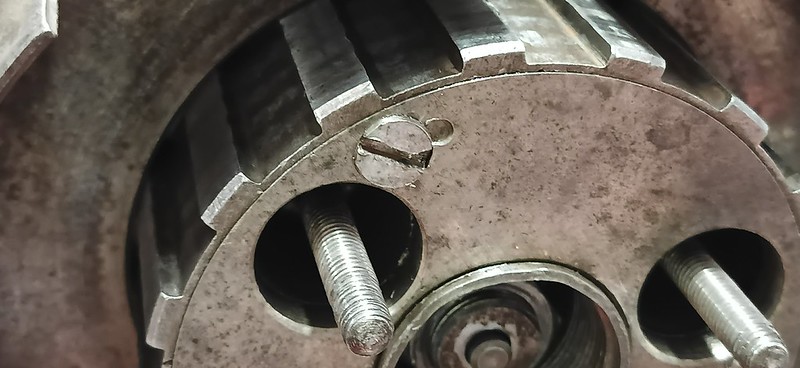
Then went back to cleaning the rest of the clutch plates.

As I think I said, they're sintered metal plates, not cork, so need to be clean and kept dry.
Eventually I got them all done,
Hopefully they're all in the same order and orientation, I tried to keep them the same: apparently they "set" a bit like brake pads do.

Then I tidied up the adjuster screw in the pressure plate

Including cutting the slot a bit deeper

Much better!

Before I completed the clutch refit, I turned to the gearbox to have a think about this issue of oil apparantly getting down the clutch push-rod tube.
Firstly I realised that the inspection cover must be an aftermarket item...

Because there's no breather hole in it

There's supposed to be a pinhole to allow the gearbox pressure to equalise as it gets hot and cold. Without it, the only pressure relief passage that the gearbox has is the clutch push rod tube...

I've been doing some research and there's 2 fixes for this issue that are generally agreed upon (at least within the Norton Owners Club anyway....)
Fit a breather tube to the gearbox to allow pressure equalisation by a different passage, and/or modify the push rod to carry one or two o-rings to prevent the oil getting to the clutch.
I've decided to do both.
So - I first dug out a few o-rings to see if I had anything reasonably close to the size.
This is a tad large.

but I have a few more...

closer

Maybe too small?

Eventually I found something close, and started the cut the small channels in the push-rod.
The clearance between the push rod and the gearbox mainshaft is minimal, and the o-ring mustn't interfere too much with the movement of the push rod, so the o-ring needs to protruce from the surface of the o-ring by only a tiny amount.
Which means cutting the little channels is going to be a "little bit, and check" "repeated and often," sort of job, which is why it's still not finished!
I'm doing the cutting by putting the push-rod into the drill and applying a very small file to it as it rotates. The file is ~1.22mm wide, and the channel should be "around" 0.7mm deep, which is going to depend muchly on the o-rings I think.
This is roughly what 0.75mm looks like compared to the thickness of the rod.

While I was faffing with this process, I inadvertently lost an o-ring in the sodding shaft.

??


 Recent Posts


 ) not scratch.


